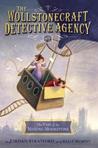
 The Case of the Missing Moonstone by Jordan Stratford
My rating: 2 of 5 stars
Rated G.
You cannot possibly be serious. There is only so much Deus Ex Machina that I can reasonably take, and The Case of the Missing Moonstone surpasses that boundary spectacularly. I kind of want to say that it is a problem when the most interesting part of a book is the Notes section at the back. I mean, it's a cute story, but I think the main value of the book is its historical value, which is admittedly dubious. Shall we explore the Sins?
Sin #1: Every historical fact/figure is obscured or changed until the book has no real value as a historical fiction book. Is the purpose to be historical? Well, no and yes. Based on the story and the dates alone, the answer is no, but according to the concluding Notes, the majority of the story's cast is composed of real historical characters such as Charles Dickens, Mary Wollstonecraft Godwin (later Shelley), Percy Bysshe Shelley, Augusta Ada Byron (later Lovecraft), George Gordon Byron, and more.
The problem is really that nearly all of the characters' dates are totally switched around. For instance, the two heroines are, for the purposes of the story, only three years apart, whereas in real life, they were eighteen years apart. One of the characters should have been dead years before. Some never met in real life. Some didn't survive childhood. SO MUCH is made up that it is kind of ridiculous, especially when the characters are actually based on real people.
In other words, here's my take on it: If you are going to make everything up, make up the names, too. Don't even bother connecting these characters to history, or, if you really want these particular characters, make it an obvious alternate history. Go ahead and base the eleven-year-old girl on Ada Byron, and go ahead and base the fourteen-year-old girl on Mary Godwin, but for goodness' sakes, if you are going to make time and people do whatever you want them to do, don't even bother connecting it so obviously to historical people and places. You can cite your sources and inspiration, but don't pretend that these characters are the same as the real people. THEY. ARE. NOT.
This doesn't always bother me, but when it is carried to such an extent and in conjunction with many other Book Sins, you'd better believe that I am no longer amused.
Sin #2: Oversimplification Okay, perhaps this can be chalked up to being an elementary/middle grade book about the 19th century. Nevertheless, this feels like a cheap knockoff of Nancy Springer's Enola Holmes. Enola Holmes has character, verve, spunk--whatever you want to call it. Oh, and her methods and struggles both are kind of more realistic, even when they are somewhat improbable. For those of you who want to say that at least Mary and Ada use science and math, Enola also solves puzzles, cracks codes (that readers can learn to use!), and uses various methods of deductions to crack the case.
***BONUS: Enola Homes is the fictional sister of a fictional character, THE Sherlock Holmes, so there can be a bit of historical fiction mixed in with the admittedly fictional characters! The problem with completely recreated history kind of goes out the window since the Holmesian world is an alternate version of Victorian England anyway, colliding a few times with reality (e.g. Florence Nightingale makes a few appearances, and the Crimean War is mentioned). She has genuine struggles with the villains, with society, and with her brothers, who want to send her to boarding school.***
Ada and Mary are totally different. Ada is a spoiled child who runs rampant over all of the servants. (Okay, that's realistic. Never mind that point.) Mary, though, plays at being rebellious but isn't really. She rides in a carriage unchaperoned every day, but that's pretty much it until she helps Ada create a detective agency. And everything just feels clean and pretty and just like the illustrations. No shadows. No crinkles. Perfect hair. Convenient happenings. Just look at the cover and you'll see what I mean. All of the illustrations match (they are in black and white and shades of beautifully shaded gray). If you don't mind stories with characters whose dresses don't have a single fold or crinkle and their lives are drawn out in colored pencil, you'd probably like this book.
Sin #3: Deus Ex Machina, Meet Deus Ex Machina Ready or not, here I come! This is what really threw me into a snarling fit of book-rage. (Well, not really, but pretty close.) THE CONVENIENCE OF EVERYTHING IS BEYOND BELIEF.
Take the opening chapter, for instance. In what universe is a young Lady (eleven years old at the beginning of the book, which means that she had to have been ten years old or younger when she first conceived the idea) ever gifted with the materials, manpower, and sheer know-how to make a functional hot-air balloon? I'll grant that it is possible for an child prodigy to have a mind like a steel trap that can conceive of this. But to actually create it? That requires significant cooperation from a LOT of consenting, intelligent, wealthy, and supportive adults. Recap: Ada somehow designed and created a functioning hot air balloon, even though she has only two supporting adults in her life, BOTH of them servants, and despite her extreme youth and inability to function outside of the home. And remember that this is 19th century England, and the young lady in question is the daughter of Baroness Wentworth (who admittedly neglects her daughter, but STILL). Nope. Nope. NOPE. I need significant explanation for that particular occurrence.
Then we have the whole prison incident. Two wealthy young girls are allowed to get into a prison unchaperoned and then are able to wheedle their way out of prison by claiming that they are impoverished orphans. By the way, they couldn't use that excuse to get into the prison because they have fancy dresses and hats on. And I don't think that an actual prison guard would (a) allow such girls into the prison without interrogating them as to their purpose AND with an adult's supervision BECAUSE THIS IS 19TH CENTURY ENGLAND AND THIS IS NEWGATE PRISON AND THESE ARE CLEARLY UNSUPERVISED WEALTHY CHILDREN or (b) refuse to let them out again after having let them in, clearly understanding that they are not, in fact, prisoners who need to be kept in in the first place.
And I absolutely CANNOT finish this review without mentioning that appalling ending. Beware. Spoilers abound.
Let's list the incidences of Deus Ex Machina, shall we?
1. These two paragraphs:
A huge chuff sent a shot of black smoke, up from the water as a round-bellied steamboat chugged to life. The two constables turned toward the distraction. [YOU HAVE TO BE JOKING. ARE THESE PROFESSIONALS OR NOT?! These people are on a DOCK. In LONDON. Steamboats HAPPEN!] Abernathy, still in irons, used the cuffs to strike the first constable in the head, knocking him down, and then sharply shouldered the second constable into the river with a resounding sploosh. [Reeeeeally? Also, how close are they to the water again, being [supposedly] thinking individuals on a dock?]
Peebs turned at the commotion to see the thief leap aboard the little chugging boat [even though he should be having some balancing issues due to the irons on his wrists], scramble to the wheel, and overpower the captain, tossing him overboard with the constable [The captain and two constables are wimps compared to a fishmonger!!!] . Mary and Ada watched, mouths agape, as Peebs ran to the deck's edge Why is an unencumbered young man unable to catch up to a fettered person trying to gain control of a totally unfamiliar boat that he probably doesn't know how to drive]. But Abernathy had gained control of the boat and was picking up speed. He was getting away! [Refer to my earlier skepticism as to his ability to master the controls of a boat while his wrists are tied together with irons]
2. The protagonists' ability to catch a cab by the dock and hightail it back to their mansion in time to get to the hot air balloon, launch it on its maiden voyage because it has been conveniently functional and, one assumes, full of hot air for an unspecified length of time...probably months, if not a year or more, and ride it back to the dock in time to catch the villain.
3. The hot air balloon itself (which is miraculously fully functional, despite the fact that an eleven-year-old girl designed and created it with an unspecified amount of responsible adult supervision, money, and labor).
4. Mary's unforeseen, unpredictable, and entirely unprecedented ability to think ahead of Ada and grasp the mechanics of a hot air balloon, despite the fact that she has people skills while Ada has mechanical/technical/mathematical skills. This is reinforced throughout the entire novel. You DO NOT get to make a girl a quick-thinking engineer after establishing her experience with literature and people above math and machines for about 250 pages.
5. That remarkably convenient southerly wind that steers the unsteerable hot air balloon (on its maiden voyage, no less) straight to their destination in very little time.
6. The fact that the hot air balloon (with minimum adjusting) manages to crash straight into the steamboat at which they are aiming, thus completely discombobulating the thief. Oh, and don't forget this paragraph:
The thief could not possibly have been prepared for being bashed in the head with a giant wicker basket inhabited by two remarkably clever and resourceful girls, so he wasn't. The gondola clocked him at a decent-enough speed so as to knock him out cold [WITHOUT killing him, you'll notice! This is a G/PG-rated book, after all!] before it crashed into the engine, tipping the girls over sideways and spilling them to the deck. [Again, no injuries, despite this convenient thief-catching hot air balloon crash into a steamboat.] Sparks and soot flew, and despite the rain, the balloon's tattered fabric soon was in flames.
Remember what I said about having a boundary of belief? I can endure pretty much all sins...up to a point. When a book crosses that line, I am totally okay with going on a full-on crazed book rant. And now that rant is over. Thank you. You've been a wonderful audience.
View all my reviews

No comments:
Post a Comment